
Eurpoors vs. Florida Man


While writing my last post, I stumbled on a Krugman piece that reminded me about the time Trump’s ambassador to the EU claimed (quoting Krugman) “that Europe is as poor as Mississippi and Germany as poor as West Virginia.” (“To which the immediate answer should be that if that’s what your numbers say, your numbers are wrong,” quoth Krugman.)
This type of US state vs. European country comparison is now a flourishing genre on Twitter, I’ve noticed, where MAGA chuds chortle at the Europoors. Their favored metric for such exercises seems to be per capita GDP — never mind that 15-25% of GDP is typically depreciation, or that the Republic of Guyana, a country with a life expectancy lower than Cambodia’s, has a per capita GDP higher than Pennsylvania’s.
I thought it would be worth seeing what more plausible numbers might look like. Here’s per capita income for the bottom 95% of the population, as measured by the World Inequality Database’s pre-tax national income series.1 And while we’re at it, why not also look at per capita hours worked, which are taken here from the Conference Board’s Total Economy Database via the Penn World Table2. All data are from 2023.
For those keeping score at home:
Massachusettsians are 7% poorer than the Dutch but work 19% more hours
Californians are 6% poorer than Swedes while working 21% more hours
Belgians are 6% richer than New Yorkers while working 24% fewer hours
The French are 2% richer than Floridians while working 27% less.
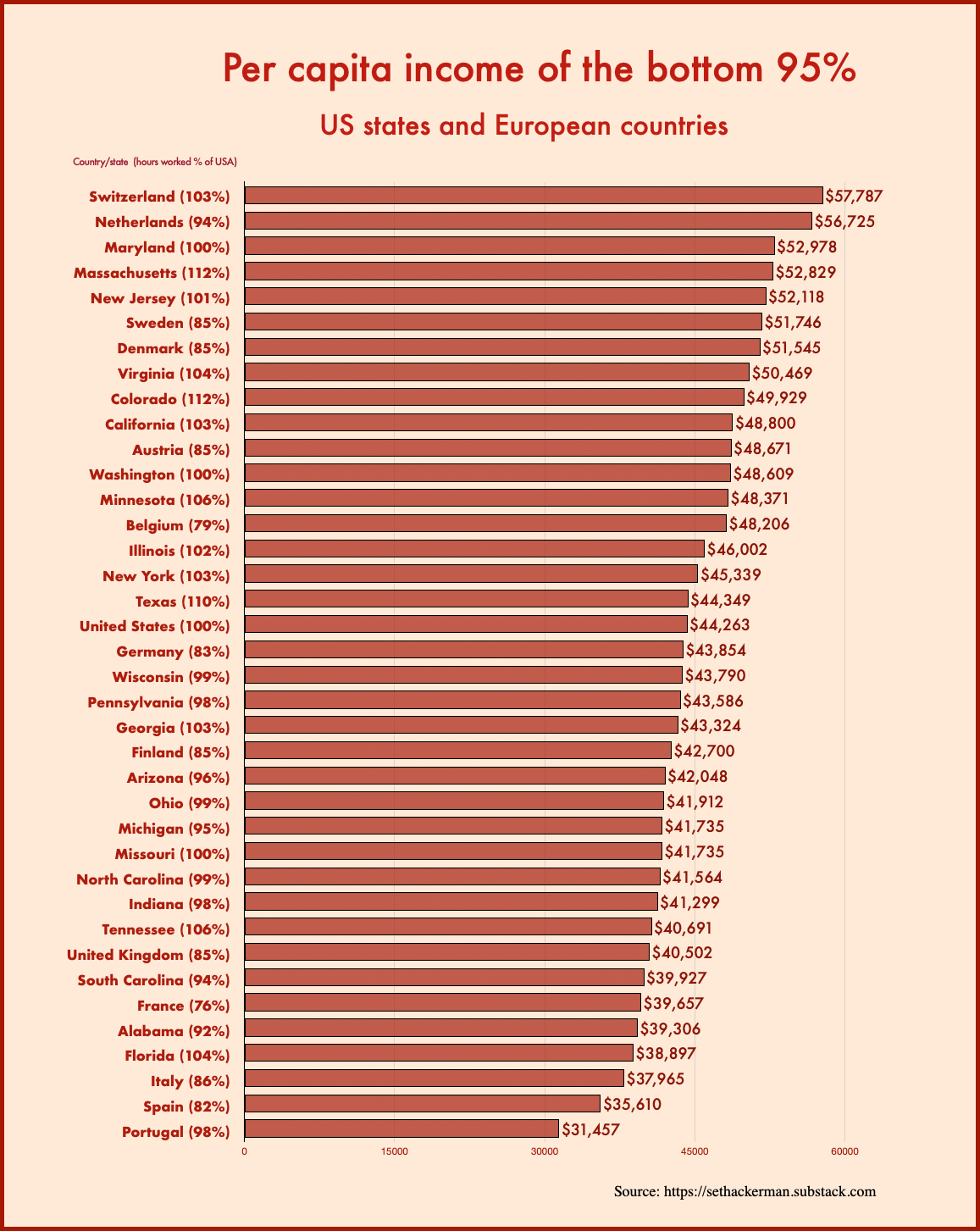
The US income total is allocated to the states in proportion to average cash income for the bottom 95% of households from the Census; current PPPs are applied to European incomes, as well as to state incomes using the BEA’s Regional Price Parities — which does some interesting things to the state rankings.
US hours are allocated to states in proportion to total jobs and average weekly hours on private payrolls, from the BEA and BLS respectively.
As someone who lives in Sweden but regularly visits New Mexico to visit my wife's family I have long suspected that GDP was not that informative given the fact that they have similar per capita gdp. I really appreciate seeing this layed out in such clear terms.
This is great Seth, keep the analyses coming. All the best, Steven Hill