
President Xi, Please Rescue My Suffering People From "the Kill Line."
As living costs skyrocket and crypto assets crash, impoverished American teens look longingly to the East in hopes of escaping THE KILL LINE.


This morning, the Guardian’s Amy Hawkins offers a delightful split-screen portrait of global consciousness, highlighting two trends playing out in parallel on US and Chinese social media.
On US platforms like TikTok and Instagram, “young people are diving into the joys of Chinese culture – from drinking hot water to playing mahjong – all under the banner of ‘Chinamaxxing,’” she writes.
On the Chinese internet, meanwhile, “the US is losing its decades-long grip on soft power, and is instead being replaced by a darker trend: the kill line.”
Hawkins explains that Chinese social media, blogs, and academic journals have lately taken to depicting “a vision of the US as a dystopian capitalist hell,” governed by what a Chinese news presenter called “a ‘kill line’ in American society where the middle class plummets into the underclass.”
The kill line “exposes America’s dual nature: the winners achieve ultimate success, while the losers fall into an abyss from which there is no return.”
The backstory:
The latest trend started in November, when a Chinese student living in Seattle posted a five-hour stream to the Chinese video-sharing website BiliBili. In the video, which has since attracted more than 3m views, he describes seeing hungry children at Halloween and the harsh realities of life for disadvantaged people in the world’s biggest economy. Soon, the term “kill line” took on a life of its own.
The meme has so captured the Chinese imagination that at a press conference at Davos in January, Treasury Secretary Scott Bessent was repeatedly asked to comment on the kill line by a Chinese state media journalist.
“I don’t understand the question,” he replied. (No kidding.)
Bernie Sanders never tires of pointing out that 60% of Americans live paycheck to paycheck, which infuriates a certain type of online wonk for some reason. When I posted about the phenomenon last year, I illustrated the point with the chart below, which shows that while the rich in the US have been stockpiling ever-larger cash buffers as a percentage of income, the rest of the population has been unable to follow suit:

As it turns out, Americans are uniquely incapable of building savings buffers from their incomes.
You can see this in the chart below, which plots disposable income1 against non-retirement financial assets2 for households at each decile threshold of the income and asset distributions, from the 10th to the 90th percentiles, in nine countries. (The data are taken from the Luxembourg Wealth Study, which harmonizes the numbers to make them comparable across countries. For data mavens, “non-retirement financial assets” corresponds to “financial assets” (FIN) minus “quasi-liquid retirement accounts” (RETQLIQ) in the Fed’s Survey of Consumer Finances.)
All data are from 2018 or 2019 (except for France which is from 2014).
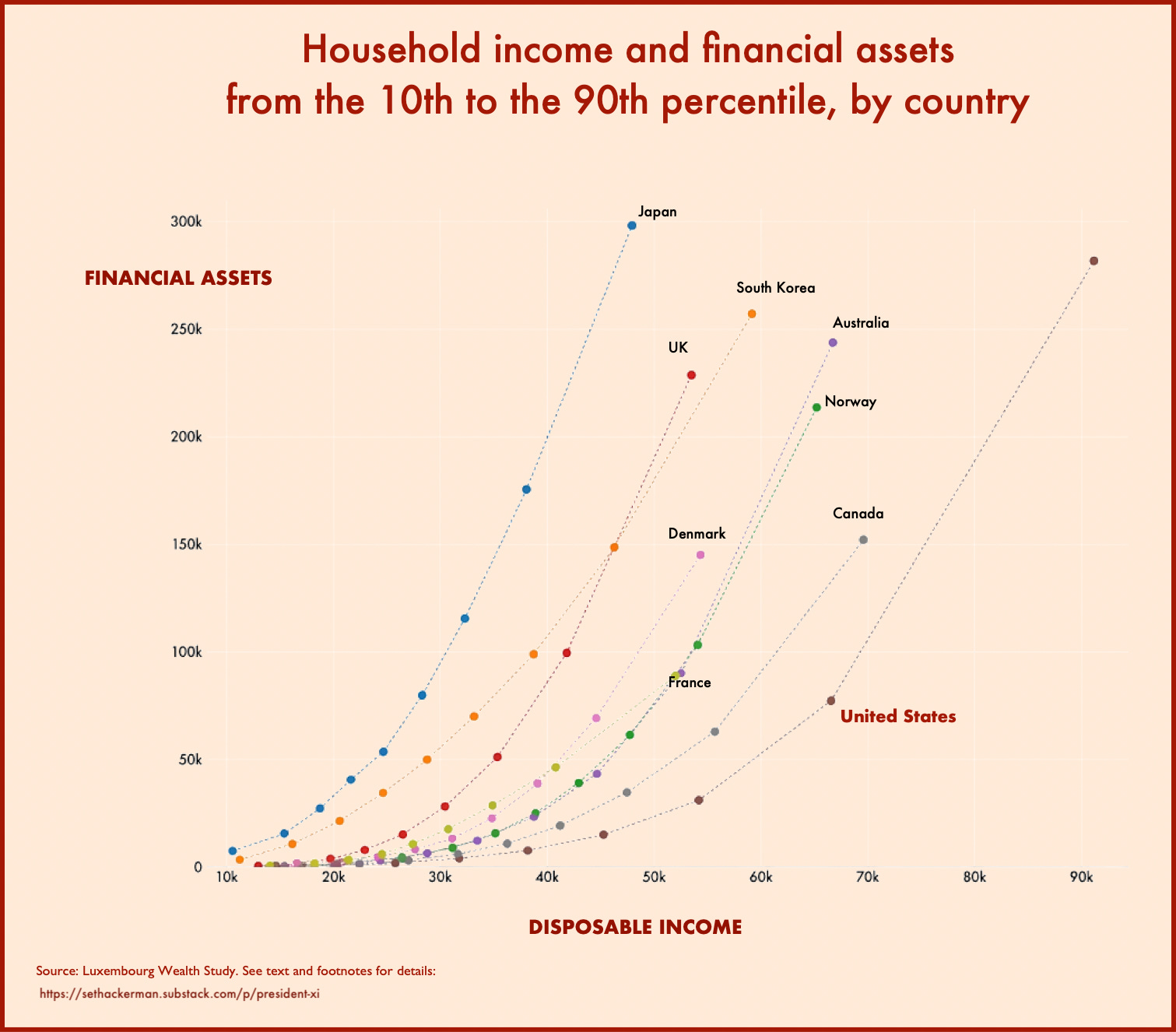
So, for example, while the median Australian household has 12% less disposable income than its American counterpart, it has 60% more in financial assets. In Canada the numbers are 5% less income and 43% more assets. In Denmark it’s 19% less income and 74% more assets. In France it’s 28% less income and 41% more assets.
One clue as to why this may be the case is supplied by the OECD’s technical manual for disposable income statistics, which I quoted from in my last post:
As the manual puts it, disposable income excludes “goods and services provided by government that benefit individuals but which are provided free or at subsidized prices,” which “generally include education, health, social welfare, transport and cultural services”...
This omission “presents difficulties when the provision of such services differs greatly” between countries because in countries where such public expenditures “are relatively sparse, a higher income will be required to support a particular standard of living than in a country where a wide range of benefits are provided, all other things being equal.”
But statistical exegesis is of little comfort to America’s destitute and house-bound TikTok teens, who can only gaze longingly at Chinese savoir-vivre through their tiny internet portals:
While internet users in China are gawking at the idea of a US riven by poverty and chaos, for their American counterparts it is quite the opposite.
With “Chinamaxxing”, American teenagers are reveling in traditional Chinese lifestyle hacks such as drinking hot water or wearing slippers indoors. The trend’s slogan? “You’ve met me at a very Chinese time in my life”.
Defined by the LWS as “cash and non-cash income from labour, income from capital, income from pensions (including private and public pensions) and non-pension public social benefits stemming from insurance, universal or assistance schemes (including in-kind social assistance transfers), as well as cash and non-cash private transfers, after deduction of the amount of income taxes and social contributions paid.”
Defined by the LWS as “the market value of financial investments (bonds and other debt securities, stocks and other equity, investment funds and alternative investments), deposit accounts, cash and other financial assets owned by household members. Aggregate Financial Assets excludes pension assets and other long-term savings.”
As far as I know (I don't know much about young people here) we don't have the same trend here in Europe, but I'm sorry to say we share the same impression.
I mean, maybe we don't (well, let's say 'not everyone') see the US as a 'capitalistic hell', but we all know the 'American Dream' comes with the heavy 'basically no social security' trade-off. Everybody here seems to despise taxes, but everybody loves being able to go to the hospital from time to time, for themselves or their kids, and I've basically almost never met someone whose dream was to emigrate to the US.
As for the foreign policy, yes, your actual government is clearly a PR disaster, but there's also some sort of silent consensus here on the fact that they're only speaking and doing without manners (brutally) the same things the US governments have been 'politely' doing for the last 60 years.
While this piece offers an interesting perspective on internet trends, it lacks relevant data and robust argument analysis.
Broadly speaking, while multiple data points in this article show how unequal the United States' wealth distribution is compared to Europe, there are no data points illustrating the Chinese wealth distribution by itself or in comparison with anything else. An easy inclusion could have been the GINI coefficients of the two countries: 41.8 in the US vs 36.0 in China (per World Population Review). These data, while basic, would have done more to support your argument than the graphs you did include.
On a more detailed level, you omitted much of the information contained in the Guardian article you cited. Amy Hawkins describes several of the reasons for an 'apparent' absence of a kill-line in China compared to the United States:
-Social support for homeless/jobless people is stronger in China and helps alleviate harms from the very high youth unemployment rate.
-State-sponsored media is actively pushing the narrative that things are worse in the US to (theoretically) stoke nationalism and distract from economic problems at home. There was a documented case where state media used an example of a homeless man down on his luck in 'the US' who turned out to actually live in London.
-The homelessness data in China are less reliable because of the way the passport system operates, which results in millions of people being not counted as homeless simply due to leaving their municipality of birth.
Your article did not mention any of these points. If this was accidental, I hope that you would do more research for your next article. If this was intentional, I would question your ethics. Between the incomplete data inclusion and subsequent glazing of the PRC, I would almost wonder if you were paid to write this article by a propaganda arm of the Chinese government. I am no fan of severe inequality in the US, but I would hope that we can acknowledge the faults of the PRC at the same time.
All the above notwithstanding, I do enjoy reading your substack and look forward to your future posts.